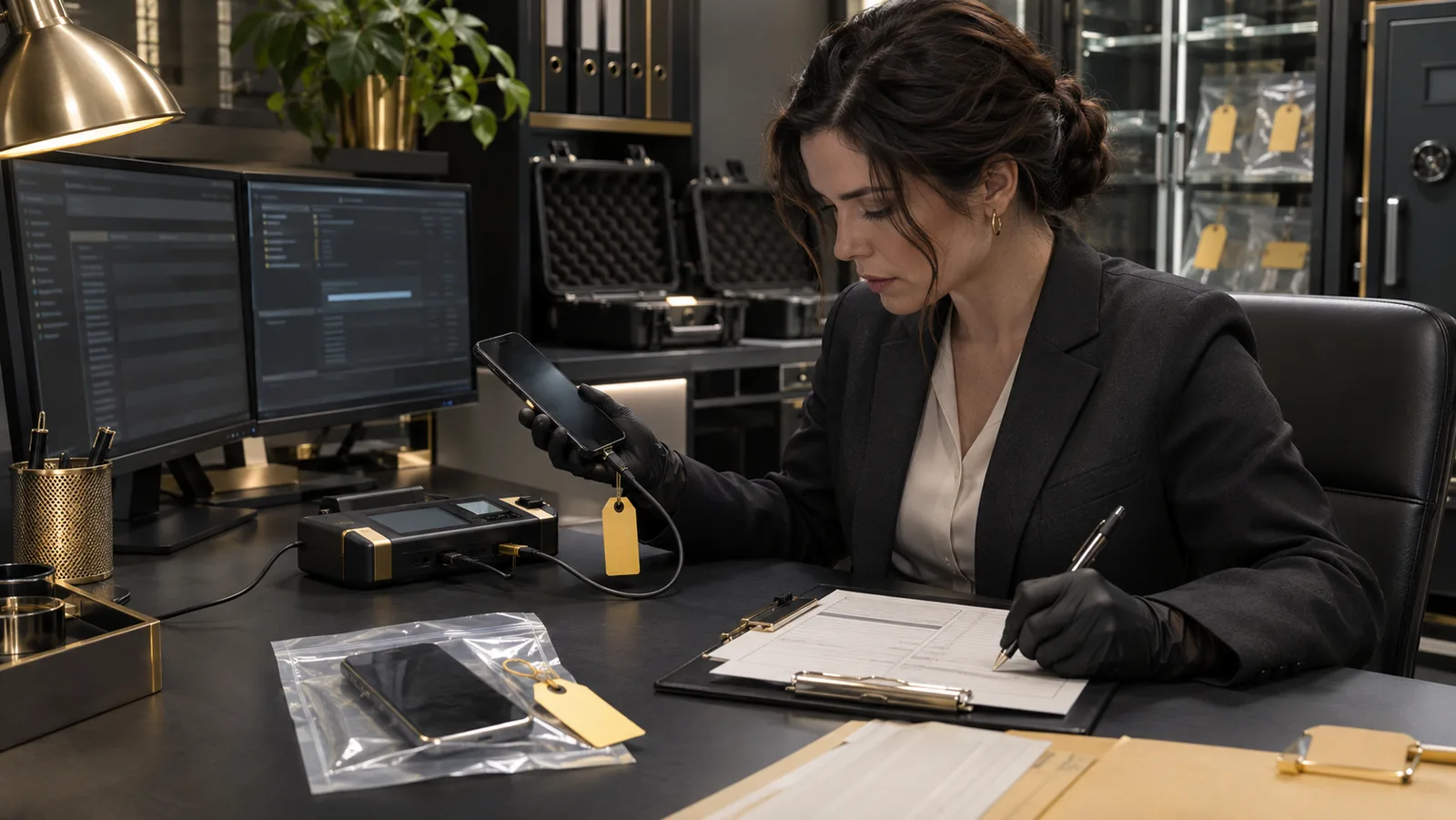
Relevant material may exist on the device, in synchronized accounts, application databases, backups or provider records. Availability depends on model, operating system, encryption, credentials, retention and acquisition method.
A focused examination begins with the legal authority and the questions to be answered. The workflow preserves source material, validates acquired data and reports both findings and gaps.
Mobile device evidence
Cell Phone Forensic Analysis With Realistic, Evidence-Based Conclusions
A mobile phone can contain communications, photographs, location-related artifacts, application records, browser activity and account information, but those records do not exist in one simple folder. Relevant material may be stored on the device, synchronized to a cloud account, retained in an application database, included in a backup or available only from a provider. A cell phone forensic expert first determines which source could answer the question and whether there is lawful authority to collect it.
Mobile evidence depends on lawful authority, device condition, acquisition method, application behavior and careful interpretation of the extracted records.
FalconGate provides focused mobile-evidence support for attorneys, businesses and individuals. An engagement may involve preserving a device, reviewing an existing extraction, analyzing messages and media, developing a chronology, assessing deleted-data claims or explaining the limits of another examiner’s report. The scope identifies the device, accounts, relevant date range, applications and disputed issues before examination begins.
Mobile-forensics results require caution. A message displayed under an account may not identify the person who typed it. A location artifact may reflect a network, photograph, application or cached record rather than continuous physical tracking. A missing message does not automatically prove deletion. FalconGate explains how each artifact was created and distinguishes supported findings from assumptions that require additional evidence.
Lawful Authority Comes Before Device Access
Ownership, possession and authority are not always the same. A company may own a device used by an employee, spouses may share an account, and a client may possess a phone that belongs to someone else. Before collection, FalconGate reviews the stated basis for access, such as informed consent, device ownership, organizational authority or legal process. Counsel should resolve disputed authority and discovery issues when litigation is active.
FalconGate does not guess passwords, bypass accounts without authority, install spyware or obtain private communications through impersonation. If records require provider assistance, account credentials, a court order or another authorized process, that requirement is documented. Establishing authority early protects the evidence and reduces the risk that useful findings become unusable.
Preserving the Phone and Its Current State
A phone continues to change through ordinary use, synchronization, updates, incoming communications and application activity. If a device may contain important evidence, unnecessary handling should stop and case-specific preservation guidance should be obtained. Resetting the device, changing accounts, repeatedly attempting passwords or deleting applications can alter or destroy available information.
At intake, identifying details, visible condition, power state, accessories and custody are documented. Preservation decisions depend on the model, operating system, battery, network state, encryption and available authority. There is no universal instruction to power every phone on or off; an examiner evaluates the circumstances and chooses a method intended to protect the available data.
Document the device, condition and person providing it
Avoid resets, updates and unnecessary application use
Preserve relevant account and backup information
Record custody and approved access credentials securely
Identify time-sensitive provider or cloud records
Mobile Acquisition Is Not the Same for Every Device
The available collection method depends on the phone model, operating-system version, security configuration, encryption, lock state and supported forensic tools. An acquisition may be logical, file-system based, backup based or another supported method. Different methods expose different categories of data, and an examiner should never describe an extraction as complete without explaining what the method can and cannot collect.
Validation includes documenting the tool and method, preserving the extraction files and checking that the acquired data corresponds to the source. When an existing extraction is provided, FalconGate reviews available logs and reports to understand how it was created. If key applications, date ranges or system records are absent, the analysis identifies that gap rather than assuming the missing data never existed.
Messages, Applications, Media and Location Artifacts
Mobile examinations may address text messages, supported messaging applications, call records, contacts, photographs, videos, browser activity, notes, calendar items and application databases. Each application stores information differently and may synchronize or delete records according to its own design. Screenshots can be useful leads, but native records and surrounding metadata generally provide stronger context.
Location-related evidence requires particular care. Coordinates may come from a photograph, map search, application cache, network event or system service, and each has a different meaning. A single record may place a device or account near a location without proving who held the phone. FalconGate compares timestamps, source mechanisms and corroborating artifacts before forming a conclusion.
SMS and supported application-message chronology
Photograph, video and available metadata review
Call, contact, browser and application activity
Location-related artifacts with source-specific limits
Account, backup and synchronization context
Deleted Data and Recovery Expectations
Deleted text messages and application records cannot always be recovered. Modern phones use encryption, database reuse, solid-state storage and application-specific retention that can remove or overwrite content quickly. Recovery depends on the device, software version, application, acquisition method, backups, synchronized accounts and how much the phone was used after deletion.
Even when message content is unavailable, related artifacts may provide context, such as conversation indexes, notifications, attachments, backups, account exports or records from another participant. FalconGate describes the source and reliability of any recovered or reconstructed information. It does not promise recovery or label every missing record as intentional deletion.
Reports, Litigation Support and Expert Review
Deliverables are designed around the matter. A focused review may produce a message chronology, media index or memorandum explaining relevant artifacts. Litigation support may require a declaration, expert report, rebuttal review, exhibits or preparation for deposition. The report identifies the examined device or extraction, methods, relevant time assumptions and material limitations.
When reviewing another examiner’s work, FalconGate evaluates the acquisition method, tool output, filters, omitted sources and whether the stated conclusion follows from the records. Clear reporting separates what appeared in the extraction from interpretation and user attribution. Counsel receives an understandable explanation of what the mobile evidence supports and which unanswered questions require another source.
The Device Is Only One Part of the Evidence
A reliable mobile investigation connects the phone, applications, synchronized accounts, backups and surrounding records to a defined question. FalconGate preserves available evidence, applies a focused method and reports conclusions at the level the artifacts can support.
Questions
Frequently Asked Questions
Can deleted text messages be recovered?
Sometimes, but not always. Recovery depends on the device, application, encryption, backups, synchronization, retention and subsequent use.
Do I need permission to examine a phone?
A valid legal basis is required, such as ownership, informed consent, organizational authority or legal process.
Can a forensic examination show who used the phone?
The device may contain attribution indicators, but an account or device artifact does not automatically prove which person performed an action. Corroborating evidence may be required.
How long does a mobile forensic examination take?
Timing depends on the device, access, extraction method, applications, data volume, relevant date range and reporting needs. A focused scope usually improves speed and cost control.
Confidential first step
Bring the Question. Protect the Evidence.
Describe the matter, jurisdiction and deadline. FalconGate will review scope, conflicts and the safest next step.